
Call Now: 480-357-5200

Surviving the Sonoran Summer: Why Arizona Desert Heat Demands Peak RV AC Performance

Surviving the Sonoran Summer: Why Mesa Desert Heat Demands Peak RV AC Performance

When the summer sun anchors itself over the Sonoran Desert, Mesa, Arizona becomes a true anvil of heat. Temperatures routinely breach the 110-degree mark, turning metal-clad recreational vehicles into thermal traps. In this environment, your RV’s air conditioning system is no longer a luxury convenience—it is a critical piece of life-support equipment. Standard seasonal preparation that might suffice in cooler climates falls dangerously short under the relentless bombardment of Arizona’s high-altitude solar radiation.

Our Service Director at Cassones RV Repair and Sales has spent decades diagnosing why standard cooling systems fail when they cross the Maricopa County line. The hard truth is that an RV sitting in 115-degree ambient heat can experience roof-surface temperatures exceeding 150 degrees. This extreme thermal load forces your compressor to run continuously without cycling, pushing electrical components to their absolute thermal limits. To survive a desert summer, you must understand the unique mechanics of desert heat transfer and adopt an aggressive, proactive approach to climate control.

Immediate survival in these conditions requires a combination of electrical efficiency, airflow management, and thermal barriers. Without proper maintenance, the delicate balance of refrigerant pressures inside your rooftop unit will destabilize, leading to rapid component failure. If you are currently parked in the Valley of the Sun or planning a mid-summer transit, understanding how to manage your air conditioner under extreme thermal stress is the single most important factor in protecting your investment and your personal safety.

As we navigate this comprehensive guide, we will break down the exact physics of desert cooling, dissect the critical components prone to heat-induced failure, and share professional diagnostic secrets. From sizing calculations to deep coil cleaning procedures, this manual serves as your definitive roadmap to staying cool when the desert tries its hardest to melt your plans.
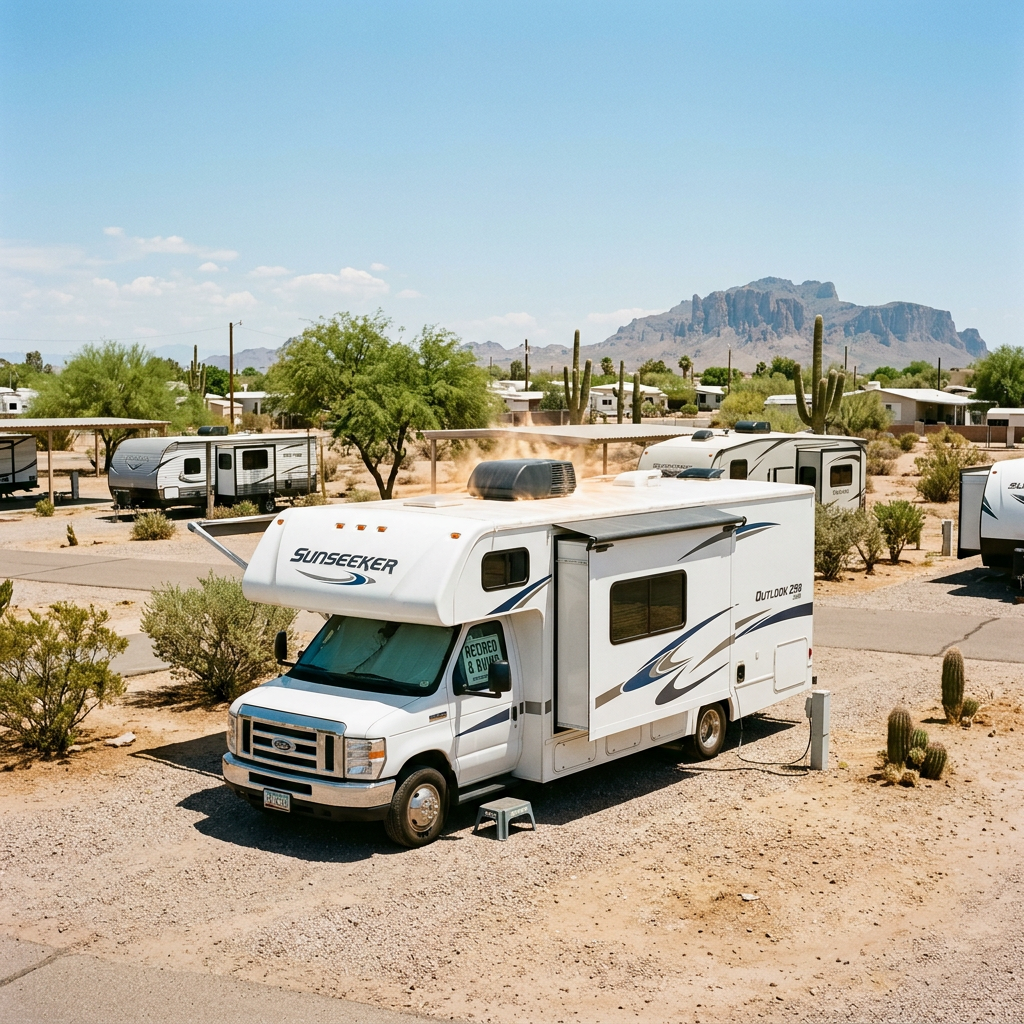
White Sunseeker RV parked in desert campground with mountains in background. (Representative image for illustration purposes only. Actual vehicle may vary based on trim and configuration.)

Meet the Service Director: Decades of Keeping Arizona RVers Cool
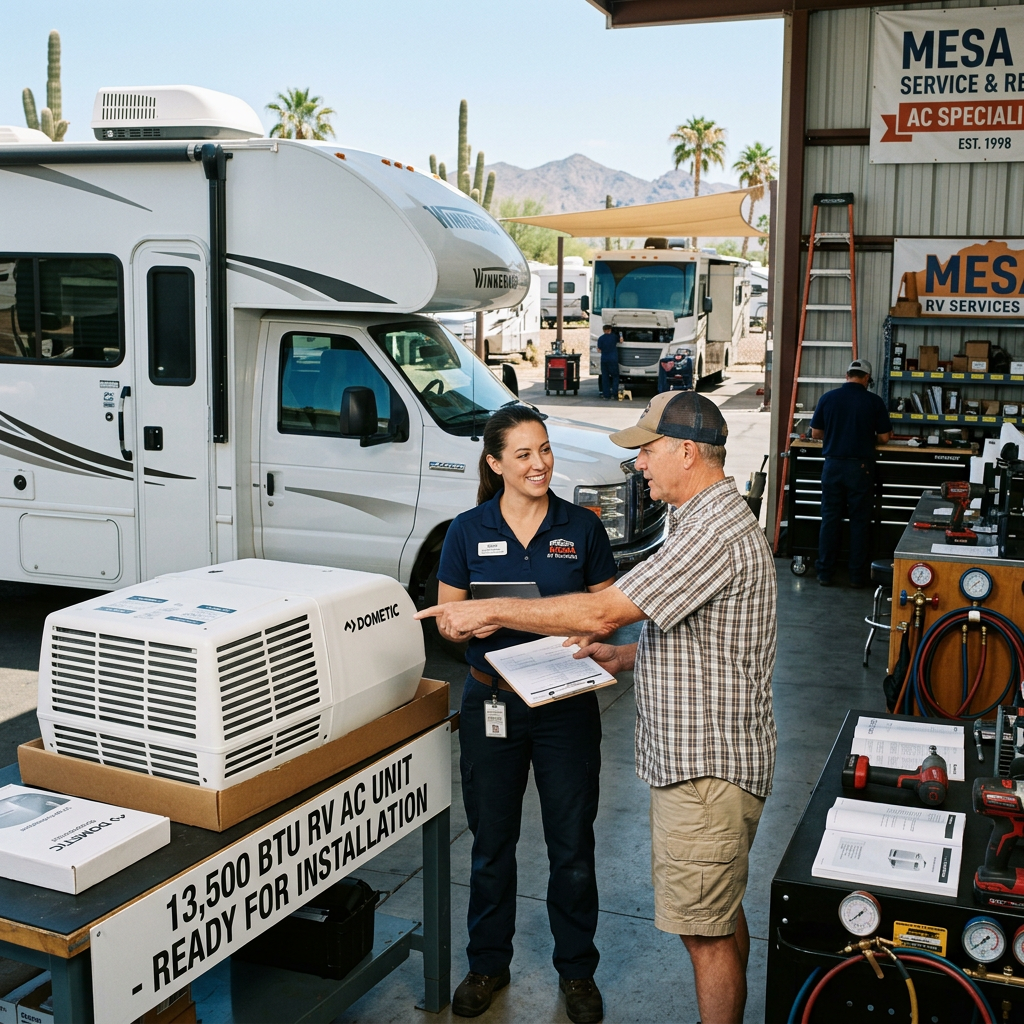
Technician and customer discussing RV air conditioning unit in service area (Representative image for illustration purposes only. Actual vehicle may vary based on trim and configuration.)

At the helm of our technical operations is our Service Director, a veteran of desert climate mechanics who has dedicated their entire career to mastering the science of mobile cooling. Having diagnosed and resolved thousands of air conditioning failures in Mesa, Tempe, and Scottsdale, they have observed firsthand how standard manufacturer designs fail when subjected to prolonged ambient temperatures above 110 degrees Fahrenheit.

Their philosophy is grounded in rigorous thermodynamics and practical, real-world testing. They believe that standard industry guidelines are built for temperate zones and must be heavily modified to handle the severe environmental stresses of Maricopa County. This passion for precision has made them a trusted authority for full-time RVers and seasonal travelers alike.

Under their leadership, our service bay has developed highly specialized diagnostic protocols that isolate hidden vulnerabilities before they trigger catastrophic roadside failures. When you trust your coach to our team, you are benefiting from a lifetime of concentrated, localized expertise that simply cannot be replicated by generalist technicians.

Can a 13,500 BTU RV AC Handle 110-Degree Arizona Weather?

To answer this question honestly, we must look at the mathematical realities of RV insulation and thermodynamic transfer. A standard 13,500 BTU (British Thermal Unit) air conditioner is engineered to cool an average-sized space by approximately 20 degrees relative to the ambient outdoor temperature. When the outside air in Mesa hits 115 degrees, a perfectly functioning 13,500 BTU unit is theoretically capable of pulling the interior down to about 95 degrees. For most travelers, an interior temperature of 95 degrees is not only uncomfortable, but it can also be physically dangerous.

The situation becomes even more challenging when you factor in the thin, lightweight insulation used in typical RV walls (often ranging from R-7 to R-11) and the significant heat gain through large single-pane glass windows. In the direct, unshaded sun of the Sonoran Desert, your RV acts like a greenhouse, absorbing radiant heat much faster than a small-capacity AC can extract it. A single 13,500 BTU unit will run continuously, trying in vain to reach a setpoint it cannot mathematically achieve. This constant operation leads to rapid overheating of the compressor and eventual electrical failure.

Does this mean a 13,500 BTU unit is completely useless in Arizona? Not necessarily, but it does mean its operational envelope is highly restricted. If you are operating a small camper van or a compact travel trailer under 20 feet with minimal slide-outs, a 13.5k unit can keep the space tolerable, provided you employ aggressive thermal mitigation strategies. However, for mid-sized travel trailers or fifth wheels, relying on a single 13,500 BTU unit in July is a recipe for system burnout.

When ambient temperatures consistently cross the 100-degree threshold, upgrading to a higher-capacity unit or adding a secondary air conditioner is the only reliable way to maintain a safe, comfortable living environment. If you want to check out your upgrade options, you can Browse Our Parts Catalog or talk to our technicians about retrofitting your roof for a dual-unit configuration.

What Size Air Conditioner Do I Need to Keep an RV Cool in the Mesa, Arizona Summer Desert Heat?

Small Rigs (Under 25 Feet)

For smaller travel trailers, Class B motorhomes, and compact camper vans under 25 feet, a single 15,000 BTU unit is highly recommended for desert travel. While a 13,500 BTU unit may survive in milder coastal areas, the extra 1,500 BTUs of cooling capacity provided by a 15k unit provides the critical margin of safety needed when temperatures surge past 110 degrees in Mesa. This size ensures the unit does not have to run at 100% capacity constantly, reducing wear on the compressor.

Medium Rigs (25 to 32 Feet)

Once an RV exceeds 25 feet or includes multiple slide-outs, a single air conditioner will struggle to maintain comfortable temperatures. Slide-outs increase the interior volume dramatically while adding multiple seals that are notorious for thermal leakage. For rigs in this category, we strongly advise a dual-AC setup: one 15,000 BTU primary unit in the living area and a secondary 13,500 BTU unit in the bedroom. This dual-zone approach allows you to balance the load and cycle the compressors efficiently.

Large Rigs (Over 32 Feet)

For large fifth wheels, toy haulers, and Class A motorhomes over 32 feet, a multi-unit configuration is non-negotiable. These coaches require at least two 15,000 BTU units, and many modern high-end luxury rigs utilize three separate units managed by an integrated energy management system. Without this level of cooling power, the massive volume of air and the heat radiating through the large windshield and sidewalls will quickly overwhelm your climate control system.

The Service Director's Golden Rule

“In the desert, prevention is your only shield. When the heat dome settles over Maricopa County, a neglected air conditioner won’t just perform poorly—it will fail completely, usually on a Saturday afternoon when parts are unavailable and mobile rates are at their highest. A simple, proactive diagnostic check in the spring saves thousands of dollars and endless frustration in July.

Is It Cheaper to Repair or Replace an RV Air Conditioner?
When your RV’s air conditioner starts blowing warm air or refuses to turn on, you face a critical financial decision: do you repair the existing unit or invest in a complete replacement? To make an informed choice, you must understand which components can be economically serviced and which signal the death of the unit. RV air conditioners are sealed systems, meaning that unlike residential systems, the internal refrigerant loop cannot be easily recharged or patched if a leak occurs in the evaporator or condenser coils.

Common electrical failures are highly repairable. Components like hard-start kits, run capacitors, fan motors, and control boards are readily accessible and can be replaced at a fraction of the cost of a new unit. If your compressor is still structurally sound and holding pressure, replacing a failed $50 capacitor or a $150 fan motor is a highly cost-effective decision that can extend the life of your unit by several seasons.

However, if the compressor itself has locked up, or if there is a puncture in the refrigerant lines, a complete replacement is almost always the smarter, more economical long-term option. Trying to solder a sealed system and recharge it with refrigerant is labor-intensive, temporary, and often approaches the cost of a brand-new, warranted unit. At Cassones RV, we carry a complete inventory of top-tier replacement units and replacement parts to get you back on the road quickly.

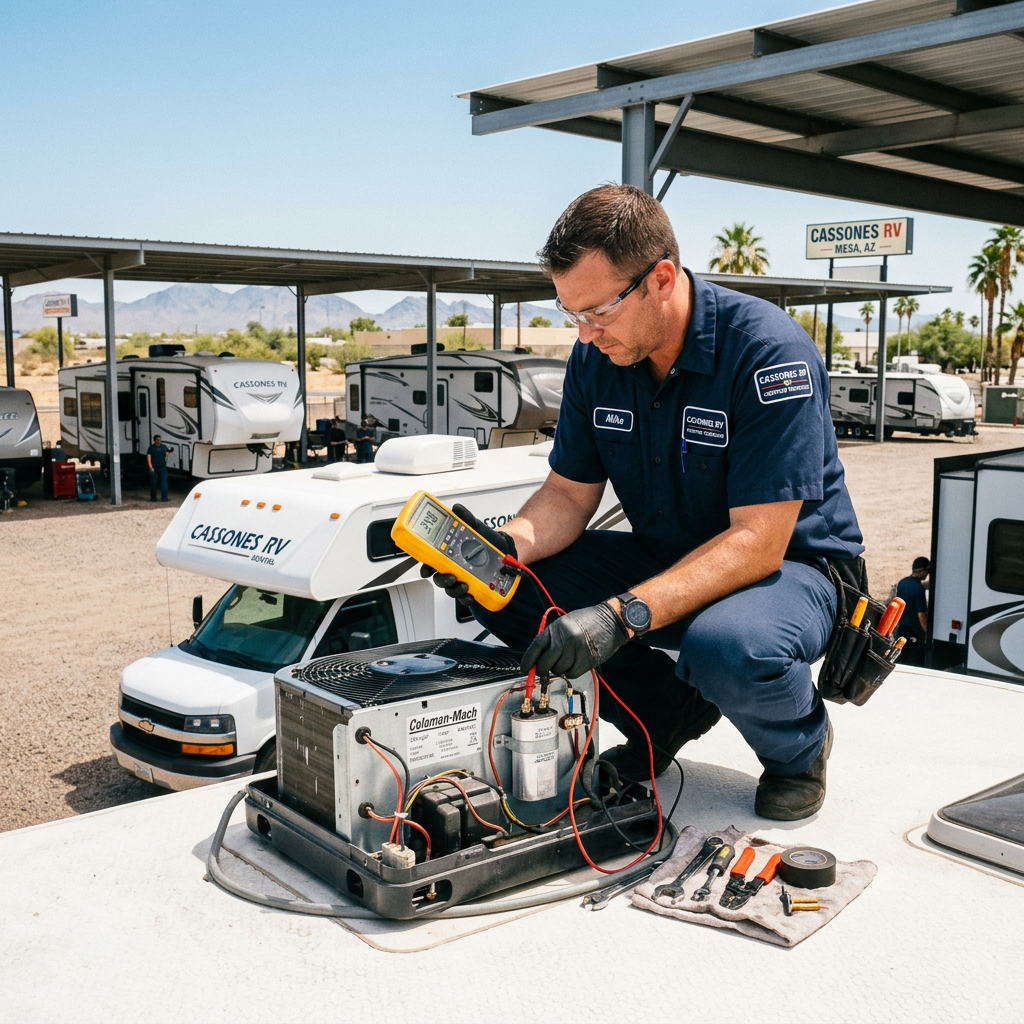
Technician testing RV air conditioning unit on rooftop using a multimeter. (Representative image for illustration purposes only. Actual vehicle may vary based on trim and configuration.)

To help you weigh your options, our team has compiled a straightforward cost-benefit comparison of common repairs versus full system replacement. Check out the diagnostic breakdown table below to see where your system stands.

Component / Symptom

Average Repair Cost

Recommended Action

Expected Lifespan Extension

Failed Run Capacitor

Low ($100 – $200)

Repair immediately

2 – 5 Years

Burned Fan Motor

Moderate ($250 – $450)

Repair if unit is under 5 years old

2 – 4 Years

Control Board Failure

Moderate ($200 – $400)

Repair

3 – 5 Years

Refrigerant Leak / Low Charge

High ($800+)

Replace entire unit

N/A (Temporary fix)

Locked Compressor

High ($1,000+)

Replace entire unit

New Unit Warranty (2+ Years)

Does RV Insurance or Extended Warranty Cover AC Replacement in Arizona?

Navigating the complex world of insurance policies and extended service contracts can be incredibly stressful, especially when you are sitting in a hot RV waiting for answers. The short answer is yes, many extended warranties and comprehensive RV insurance policies will cover air conditioning repair or replacement, but the coverage is highly dependent on the exact cause of the failure. Understanding how to document and present your claim is the difference between a fully covered replacement and a massive out-of-pocket expense.

Extended warranties typically cover mechanical breakdowns. If your compressor suddenly fails due to normal internal wear and tear, or if a control board shorts out, your service contract should pay for the replacement unit and the professional labor to install it. However, these warranty companies will demand proof of regular maintenance. If they find that the condenser coils were packed with desert dust and choked of airflow, they can deny the claim due to owner neglect.

Standard RV insurance policies, on the other hand, do not cover mechanical wear. Instead, they cover sudden, accidental physical damage. If a severe monsoon storm tosses a branch onto your roof and smashes your AC shroud, or if a lightning strike surges through the park pedestal and fries your electrical system, your insurance policy should cover the claim. In these scenarios, having our certified team perform a detailed physical inspection and write an official damage assessment is critical to getting your claim approved quickly.

To ensure your claim process goes smoothly, always keep a meticulous file of your service records, including receipts for professional coil cleanings and inspections. If you are currently dealing with a broken system and need to start a claim, you can Request Service Appointment with our experienced service writers, who can interface directly with your warranty provider or insurance adjuster.

DIY Desert Prep: How Do I Clean the Exterior Condenser Coils on an RV AC Unit?
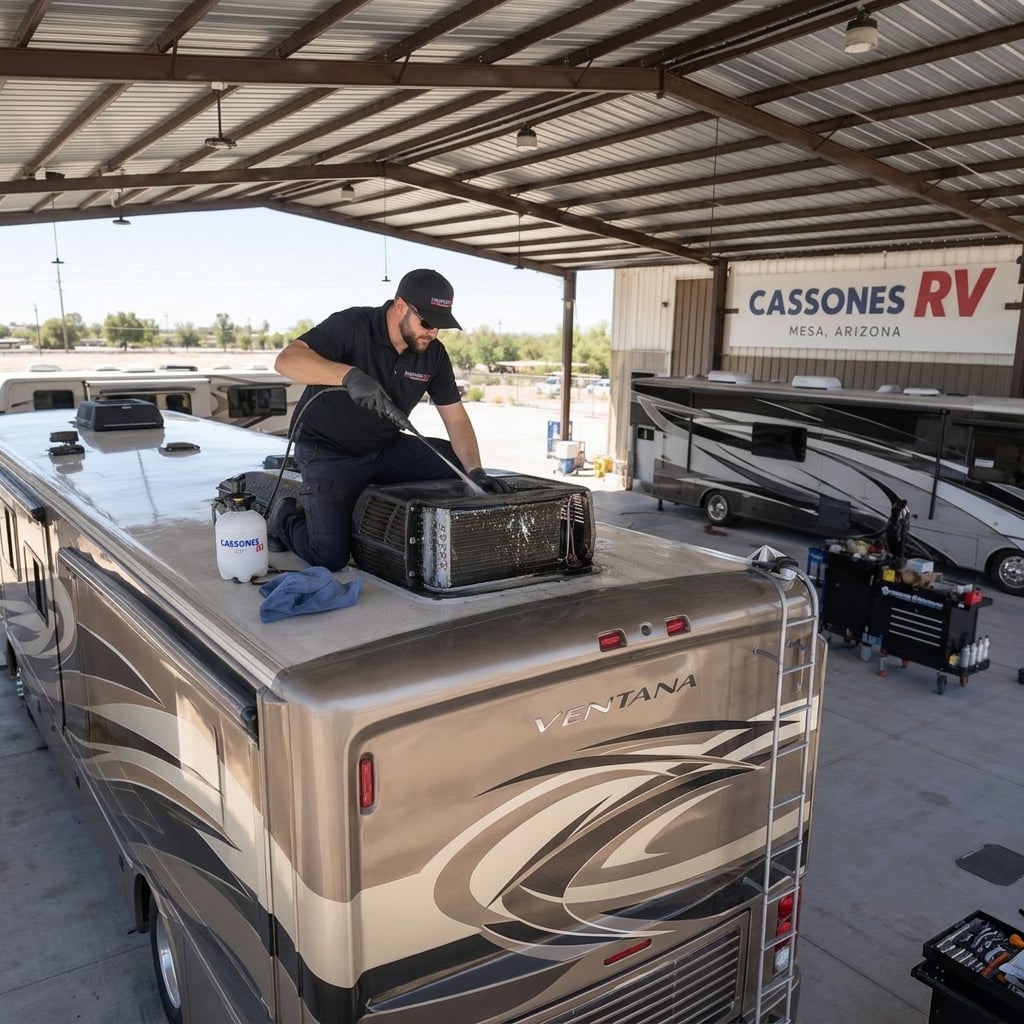
1. Safety & Preparation

Before climbing onto your RV roof, safety must be your top priority. Turn off the air conditioner at the thermostat inside, then disconnect all shore power by pulling the plug or shutting off the main breakers. If you have an inverter system, make sure it is completely deactivated. Once power is isolated, safely climb up with your tools: a screwdriver, a soft-bristled brush, a commercial self-rinsing coil cleaner spray, and a low-pressure water hose. Never use a high-pressure power washer, as it will instantly flatten the delicate aluminum fins, permanently ruining airflow.

2. Shroud Removal & Dusting

Carefully unscrew and remove the plastic outer shroud. Set the screws aside in a secure container so they don’t roll off the roof. With the shroud off, you will see the metal condenser coils at the rear of the unit. In Mesa, these coils are often choked with a thick layer of fine Sonoran dust, sand, and organic debris. Use your soft-bristled brush to gently sweep away loose dirt from the surface of the fins, working in a strict vertical motion. Brushing horizontally can easily bend the fins and restrict airflow.

3. Spraying & Rinsing

Generously spray the condenser coils with your commercial coil cleaner. Let the foaming action sit for 10 to 15 minutes to break down baked-on grime and grease. Once the foam has done its work, gently rinse the coils from the inside out using your low-pressure hose. Be extremely careful not to spray water directly into the fan motor or electrical control box. If any fins are bent, use a specialized fin comb to gently straighten them. Allow the unit to dry completely before replacing the shroud, restoring power, and testing.

The 10-Degree Difference: How Much Difference Do Reflective Window Covers Make?

When fighting the desert heat, active mechanical cooling is only half the battle; the other half is passive thermal defense. RV windows are essentially massive thermal holes in your coach’s insulation. Standard single-pane glass offers virtually zero resistance to radiant solar energy. When sunlight streams through your windows, it strikes interior surfaces—like your dashboard, flooring, and furniture—and is converted into infrared heat energy, which is trapped inside the coach.

This is where high-quality reflective window covers (often referred to as Reflectix) prove their immense value. By placing custom-cut reflective panels in every window, especially those facing east and west, you reflect up to 97% of radiant heat before it can enter your living space. Real-world thermal testing shows that utilizing reflective covers can drop interior temperatures by 10 to 15 degrees compared to unprotected windows, significantly reducing the load on your air conditioning unit.

To maximize this effect, combine your window covers with specialized insulated inserts for your roof vents and skylights. Skylights are often overlooked, but they act like chimneys in reverse, dumping massive amounts of heat directly into your living area or bathroom. Parking orientation also plays a critical role: always try to park your RV with the passenger side (which usually has fewer windows and is covered by your main awning) facing south or west to provide a natural shade barrier.

By implementing these passive strategies, you protect your air conditioner from running continuously, which drastically lowers the risk of electrical failure or freeze-up. If you are looking to upgrade your RV or trade in a coach that struggles in the heat, you can Value Your Trade-In on our website and browse our inventory of late-model coaches featuring superior, dual-pane thermal windows.

Do Mobile RV Technicians in Mesa Charge a Higher Rate for Weekend or After-Hours Service?

When your air conditioner fails in the middle of a scorching Arizona summer night, your immediate instinct is to call the first mobile RV technician you can find on your phone. However, before you authorize a dispatch, you must understand the financial realities of emergency mobile services in Maricopa County. Mobile technicians provide an invaluable service, but their convenience comes at a premium that can easily double or triple your overall repair bill.

During peak summer months, standard mobile service calls during normal business hours already include a dispatch fee ranging from $100 to $200 just to drive to your location, on top of an hourly rate that often exceeds $150. If you require assistance after-hours, on a weekend, or during a holiday, those rates escalate dramatically. Emergency dispatch fees frequently surge past $300, and hourly labor rates can carry a premium “after-hours” multiplier. Furthermore, mobile techs carry limited inventory on their trucks, meaning they may charge you a second trip fee if they have to source parts on Monday.

In contrast, scheduling your diagnostics and repairs directly at our fully equipped service center at Cassones RV Repair and Sales is far more cost-effective. By bringing your coach into our shop, you eliminate expensive dispatch and travel fees entirely. Our factory-trained technicians have immediate access to our extensive on-site parts department, allowing us to perform diagnostics and complete repairs in a controlled environment, often on the same day.

To avoid being held hostage by emergency mobile rates, we highly recommend scheduling a seasonal inspection before the summer heat hits. If your AC is showing any warning signs—such as unusual noises, weak airflow, or frequent short-cycling—don’t wait for a total system failure. You can easily Schedule RV Repair Services with our in-shop team to resolve issues at our standard, highly competitive rates.

Schedule Your Desert-Ready AC Inspection at Cassones RV Repair

Don’t let the brutal Arizona summer heat turn your long-awaited vacation into a stressful mechanical emergency. At Cassones RV Repair and Sales, our dedicated team of cooling specialists is fully equipped to handle everything from routine coil cleanings to complete multi-unit rooftop retrofits. We understand the unique challenges of Sonoran Desert travel, and we are committed to keeping your coach cool, safe, and efficient all summer long.

We invite you to visit our premier service facility located at 3032 E Main St, Mesa, AZ 85213. To make your planning as seamless as possible, you can Get Directions to Cassones RV Repair and Sales via Google Maps, or Call us at (480) 357-5200 to speak directly with our friendly service coordinators.
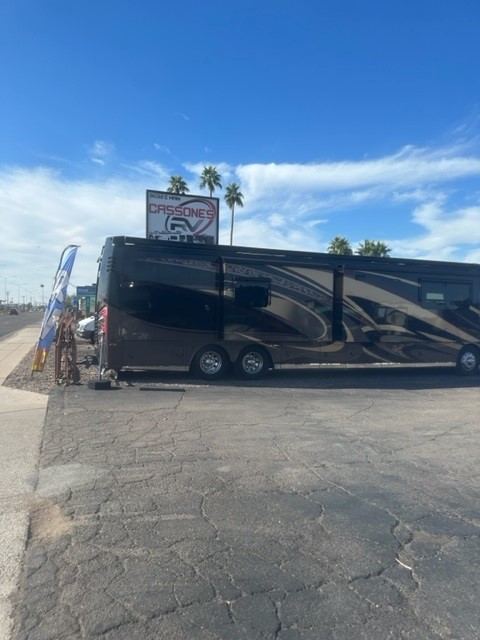
Large black and brown RV parked next to a sidewalk under a blue sky with palm trees.

Get In Touch

Contact Us

Phone

480-357-5200

Address

3032 E. Main St. Mesa, AZ 85213

Business Hours

Monday - Friday
8:00am - 5:00pm
Saturday
9:00am - 4:00pm
Sunday
Closed